
Recently, having spent a few days helping out with the national disease surveillance and control efforts in East Yorkshire I gained a greater appreciation of the level of surveillance and monitoring of exotic and notifiable animal diseases that goes on behind the scenes in the UK. Whilst infectious diseases are often at the forefront of our minds as farmers and as vets, especially in an outbreak situation, there is also a lot more going on in the background than meets the eye. This is also true within the LLM practice bubble!
The humble bulk tank ‘Infectious Disease Check’ (IDC) is carried out on a quarterly basis for our dairy herds. This monitors many of the commonly encountered infectious diseases that can cause production losses within dairy herds. For the most part these are collected by your milk recorder and carried out on your bulk tank ‘payment’ sample. For farms that do not milk record they can simply be collected from your bulk milk tank and arranged to be collected from the farm.
Our Infectious Disease Checks are therefore a great, easy way of surveying what is happening at a population level on individual dairy farms but also to look at trends across the different LLM practice branches.
The following diseases are checked every 3 months which includes the detection of antibodies for:
Infectious Bovine Rhinotracheitis – IBRgE (these antibodies are from the real ‘wild’ virus)
Bovine Viral Diarrhoea BVD
Leptospirosis
Liver Fluke
Salmonella
Antibodies are produced by the immune system when it has come into contact with an infection and are usually detected 2-3 weeks following exposure. Since these antibodies are in circulation in the blood they will cross over into the udder and be present in the milk of those animals.
The other reason for antibodies to be present may be if the herd is vaccinated for that disease (with the exception of IBR which works slightly differently due to the existence of a marker vaccine and the ability to detect a very specific antibody).
All of our farms are also checked every 6 months for BVD virus by a PCR test. If this is positive then it means a Persistently Infected (PI) animal may be present in the milking herd.
Some of our dairies have also been used to track exposure to Schmallenberg virus (SBV) based on geographical location.
All of this information can be gleaned from a volume of milk equivalent to a single shot of whisky, which is pretty cool!
So what’s the point of all this?
Regular IDC checks allow your routine vet to keep tabs on what is happening within the herd and to assess the requirement for the introduction of new vaccines or a change in current protocols. They can pinpoint a window where infection may have been introduced or even where infection that may have been present seems to have disappeared. This also gives an indication of who may have been contributing to the tank at this time i.e. has anyone new been introduced to the herd, has there been an influx of heifers that have been grazed or housed elsewhere, do we suspect exposure may have occurred in a dry cow group that have recently re-entered the tank?
They are especially important to monitor diseases on the farm to which there are absolutely no antibodies in the bulk tank for that disease as this means the herd is naïve and likely unvaccinated, hence unprotected if such a disease was to be introduced to the farm.
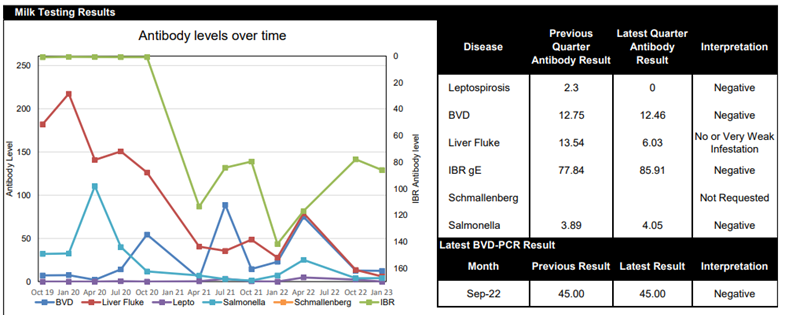
Example IDC report and interpretation for a Naïve herd
The graph above is quite a rare occurrence in the UK dairy herd, let alone across LLM, with negative results for all the diseases tested for in this quarter. However, this also means that no vaccinations are given to these animals so there could be some dramatic consequences if this herd comes into contact with one of the above diseases. This is obviously disease dependent but if there is herdwise exposure at the same time this can have impacts such as milk drop, ill health, abortion storms. This can have an even greater impact in block calving herds depending on the timing of that exposure.
It also means that robust biosecurity plans need to exist to avoid the introduction of disease. This is not the sort of herd that wants to have neighbouring cattle who are capable of jumping the fence!
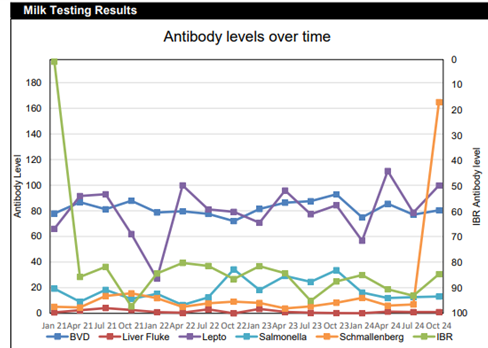
We have all been focused on the activity of midges this year since Bluetongue Virus reared its head again in August 2024. In Lancashire we have had a new surprise with some of our October bulk tank samples suddenly going highly positive for antibodies to Schmallenberg virus which is another viral disease spread by the Culicoides midge vector (as discussed in more detail by Rob Hall in the LLM February 2024 newsletter). Whilst we encountered a small number of cases in 2024 this was mainly seen in our early lambing sheep flocks and seemed to escape most of our dairy herds. This was different to what was being reported in Shropshire, Cheshire and Derbyshire, where bulk tanks went positive in October 2023 indicating exposure last year. We were hoping we may have got away with it but are waiting with bated breath to see what this brings in the Spring!
How Do We Use the Results?
The results of the IDC will be sent to you and to your regular vet via email. If there is anything unusual that we have noticed we will speak to you about any changes that have happened since your last result. This allows us to be ahead of the curve and to come up with an appropriate management plan.
These Infectious Disease Checks are a neat and simple way to see what is going on and having data that goes back several years allows us to monitor progress over time and acts as a dynamic risk assessment of the situation on farm. If you have any questions about your IDC report please ask us!



Leave A Comment